
I pressed myself against the body in front of me, resting my cheek on their warm back as I felt the person behind me do the same. We shuffled forward, squeezing together in the hot September sunshine, hearing someone shout instructions in Catalan above the excited chatter of the crowd.
There was movement around and above me as the castle began to form. I wanted to look up to see what was happening, but knew it wasn’t allowed, so I closed my eyes to avoid the temptation. Then the music began. The tune meant that the castle was growing taller, as more castellers climbed on top of one another to create a spectacular, gravity-defying human tower.
A gasp from the crowd and shouts from somewhere inside the mass of people signified something was wrong. We all held our breath, pressed even closer together and prayed for everything to be alright. I knew from watching castellers that wobbling in the tower was nerve-wracking to see, but things quitened down quickly so the tower must have steadied.
The music reached it’s climax as a small child climbed to the top of the castle and raised their hand. The crowd cheered and there was a brief moment of relief as we knew the castle had been completed.
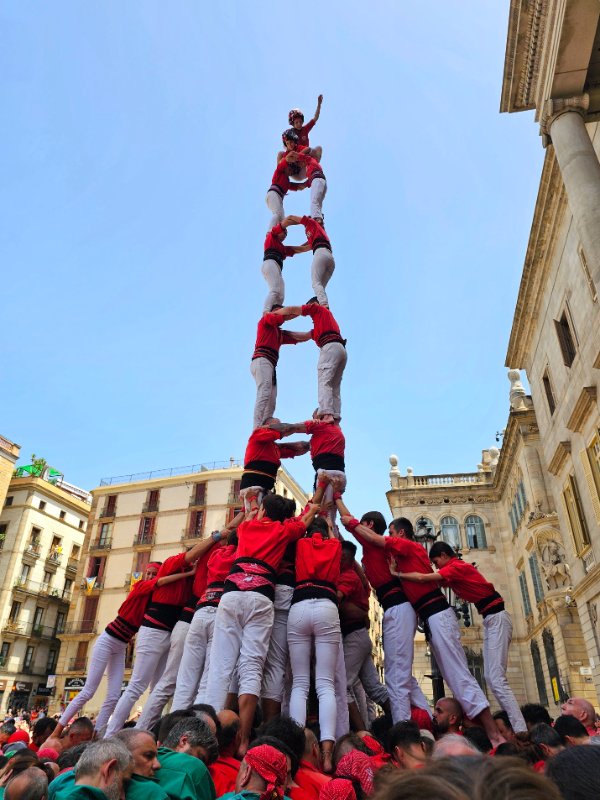
But now came the de-construction.
The smallest members of the colla were climbing down from the top of the castle, clambering over us, packed tightly in the pinya at the base of the tower, still with our faces firmly pressed into each others’ backs.
And then it was over. There was more applause from the crowd and we relaxed. I raised my head and stepped back, breathing in fresh air that you just don’t get when your nose and mouth are so close to another human being.
I had no idea what kind of castle we had made, but knowing that I was part of it for one of the biggest casteller performances of the year made it such a special experience. That was my first experience of being part of a colla, a casteller human tower team. Although I’d been to a couple of practises the week before, nothing had prepared me for this!
We congratulated ourselves, and I turned to watch, freely now, as another colla was building a tower close by.
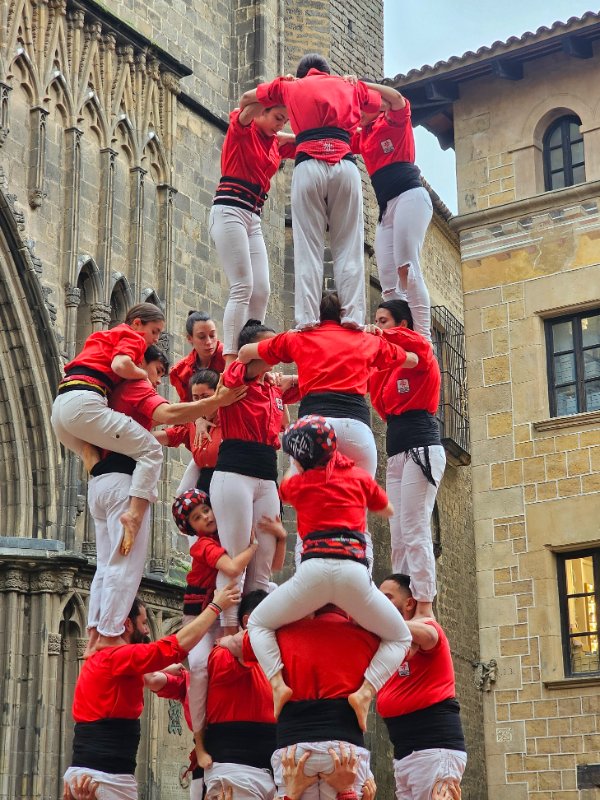
If you get the chance to watch castellers perform in Barcelona or at any time during your trip, don’t miss it! That was my experience of the Castellers de Barcelona performing at La Merce Festival in 2024. A friend of mine is in the Castellers de Barcelona and when she invited us to take part I couldn’t resist. I was part of the pinya, the base of the tower, so I wasn’t climbing on anyone but it’s still an essential part of the construction.
It was hot, stuffy and not entirely pleasant, but the excitement of being part of something that special was undeniable!
Castells are the most impressive and fun to watch of the Catalan traditions I’ve come across. Every festival in Barcelona and all over Catalonia creates a fantastic excuse for these teams to get together and create incredible human towers, an extraordinary tradition that showcases the strength, balance, and collective effort of Catalan people.

What are Castellers?
Castellers are the people who make up the castell, the human tower.
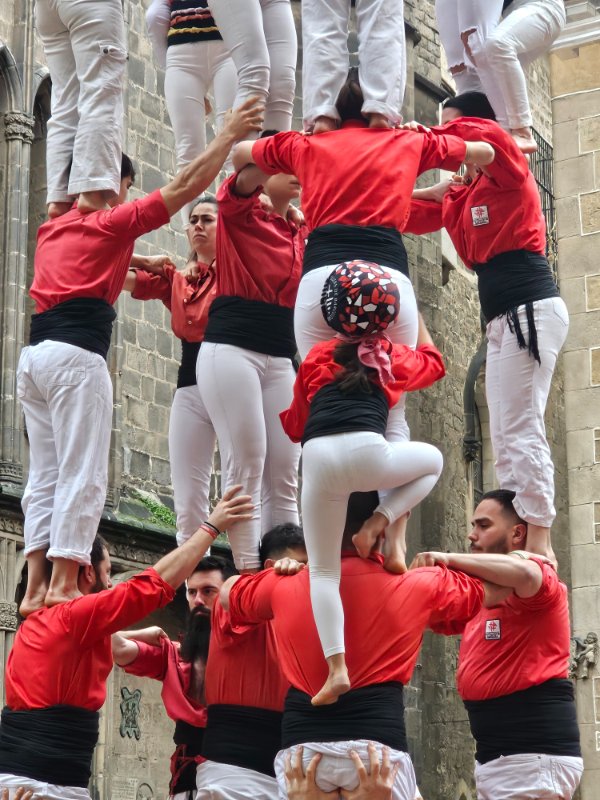
Made up of collas (teams) spanning all ages and sizes, the towers are created from a strong base, called a pinya, with a packed circle of members supporting the bottom levels, then more of the sturdiest castellers stand on their shoulders to form the first elevated level.
Above them, more levels are formed as more team members stand on each other’s shoulders, gradually decreasing in size until the smallest casteller (usually a young child of around 5 years old) clambers up to the top and raises their hand in the air in a salute to complete the tower, and then swiftly descends; followed by the rest of the tower.
The towers take some time to build, and everyone needs to be sure of the strength of the base before the levels are built. In competitions, the teams have a few minutes without music to build their bases, and if it’s decided to be not 100% steady they de-construct and start again. Once the music starts though, they have to continue and attempt to finish the structure they began.
The most dangerous part of building a castell is in fact its deconstruction and the careful descent of the upper members. They slip down each other with seeming ease, and you notice the look of relief on their faces as the ones above them climb down and the weight they bear gets less and less. Then finally when everyone is safely down they celebrate and congratulate each other on their success.
Structure of the Castells
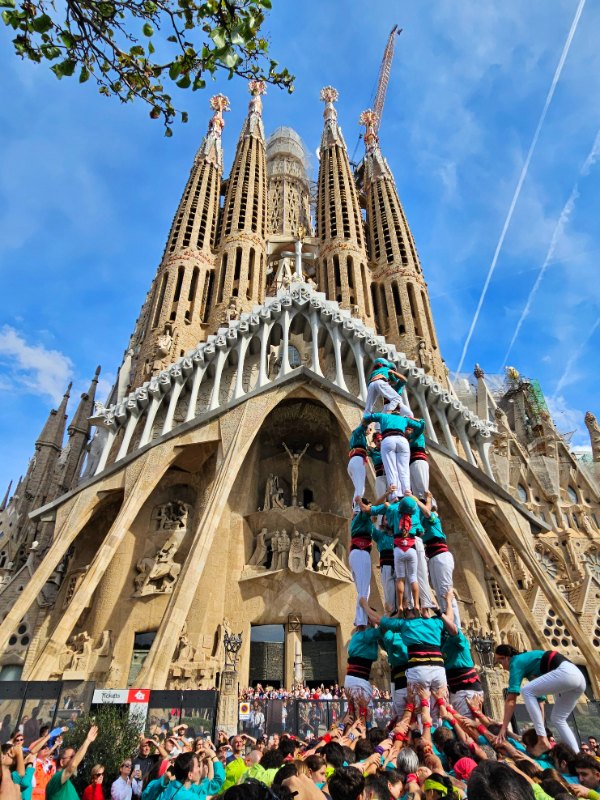
The castles have different parts which are all equally important – you can’t build a safe castle without all of them!
Base (Pinya): The foundation of the tower is called the pinya, consisting of a large group of people who form a tightly packed circle. Their role is to support the weight of the tower and ensure stability.
Trunk (Tronc): Above the pinya is the tronc, the main body of the tower, composed of multiple tiers of people standing on each other’s shoulders. The tronc can be up to 7 levels tall, with the levels of the pom de dalt on top, to make a maximum of 10 levels.
Pom de Dalt (Top of the Tower): The uppermost tiers of the castell are known as the pom de dalt. This is where the smaller, lighter castellers climb to complete the tower. The pom de dalt is made up of:
- Dosos: two smaller castellers who stand on top of the rest of the trunk
- Aixecador: another small casteller, a child, who crouches like a frog on the shoulders of the dosos.
- Enxaneta: The enxaneta is the small child who climbs to the very top of the tower on top of the aixecardor, and raises their hand in a brief salute to signal the completion of the castell. This moment is the climax of the performance, then the tower is dismantled from the top down as the members descend in turns.
Building a castell requires immense teamwork, coordination, strength, and trust. Each person has a specific role, and they work together to create a stable and balanced structure.
It’s a wonderful community activity and I loved seeing how everyone gets involved, young and old, everyone is part of the team. While spectators don’t usually see what happens below the pillar, I can assure you it isn’t easy! Bodies are squished together to form a strong, solid base which is so important to support the tower.
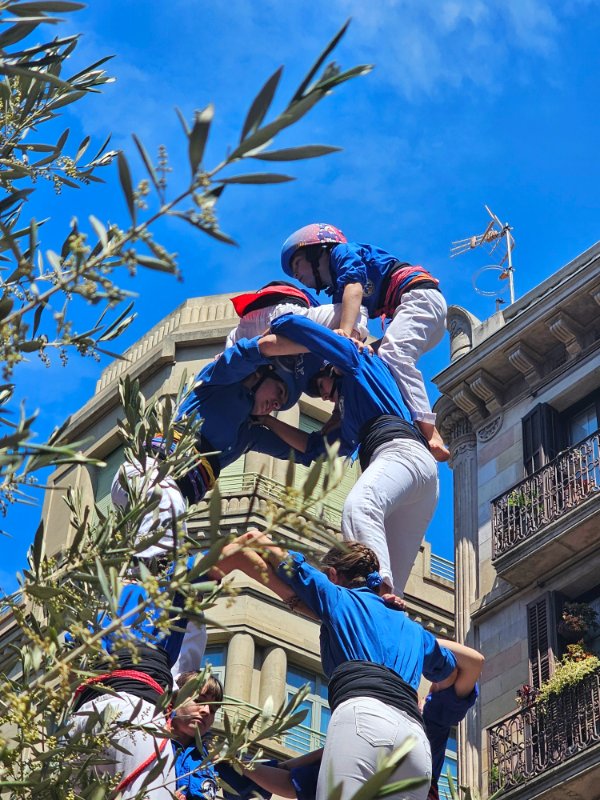
It really is a sight to behold; human strength and endurance pushed to the limits – and the bravery and skill of the upper levels as they climb up the tower like monkeys. And then a scary moment as the tower wobbles; one of the teams cries out – the crowd gasps and holds their collective breath until the tower steadies itself.
Occasionally the towers crumble and fall, but it is rare in competitions, and the base of people supporting the tower also helps to break the fall of anyone unlucky enough to take a tumble.
I have seen a tower fall, at the same festival where I took part in 2014. It was shocking to see, and the paramedics were on hand to support anyone with injuries. Usually the worst injuries are bumps and bruises, a broken nose or a concussion perhaps. Someone was carried away on a stretcher wearing a neck brace, so all precautions are taken should the tower fall. Serious injuries are thankfully rare.
The youngest castellers in the pom de dalt always wears a helmet, but usually, they are the only ones. That became obligatory after a tragic accident in 2006 when a young member died after a fall. The helmets are specifically designed to be lightweight, ventilated and shaped to absorb impacts while minimising the risk of injuring other castellers if the wearer falls.
The History of Castellers
The tradition of castellers (human towers) in Catalonia originated in the town of Valls in the late 18th century.
They evolved from an earlier folk dance called the Ball de Valencians, which ended with participants forming a small human tower as part of the performance. Over time, in Valls, this final tower became the main focus rather than just the finale to a dance, and groups began competing to build taller and more complex structures. This marked the birth of casteller culture as it’s recognised today.
From Valls, the tradition spread across Catalonia, especially throughout the Tarragona region, and eventually to Barcelona and beyond. Today, castellers are a key part of Catalan identity and are often performed at festivals and major events, including local festes majors.
The cultural importance of castellers was officially recognised when UNESCO declared them an Intangible Cultural Heritage of Humanity in 2010.
The four traditional values of castells are:
- Força (Strength): The physical strength needed to support the weight of the human tower. This applies not only to the people at the base (pinya), but to everyone in the castell working together to carry the load.
- Equilibri (Balance): Both literal and figurative balance. Castellers must maintain their physical balance while climbing and supporting the structure, and the tower itself depends on everyone remaining perfectly aligned.
- Valor (Courage): The bravery required to take part, especially for the children who climb to the highest levels. Every casteller needs confidence and determination to perform their role despite the risks.
- Seny (Common sense or good judgement): A uniquely Catalan concept referring to wisdom, prudence and sound judgement. In castells, it means knowing when conditions are right to attempt a tower, working safely, trusting the team and making sensible decisions rather than taking unnecessary risks.
The phrase “Força, equilibri, valor i seny” has become the motto of the casteller tradition and reflects the values that make the activity successful. While strength and courage are important, the inclusion of seny emphasises that castells are built through careful planning, teamwork and discipline as much as physical ability.
Teams of Castellers in Barcelona
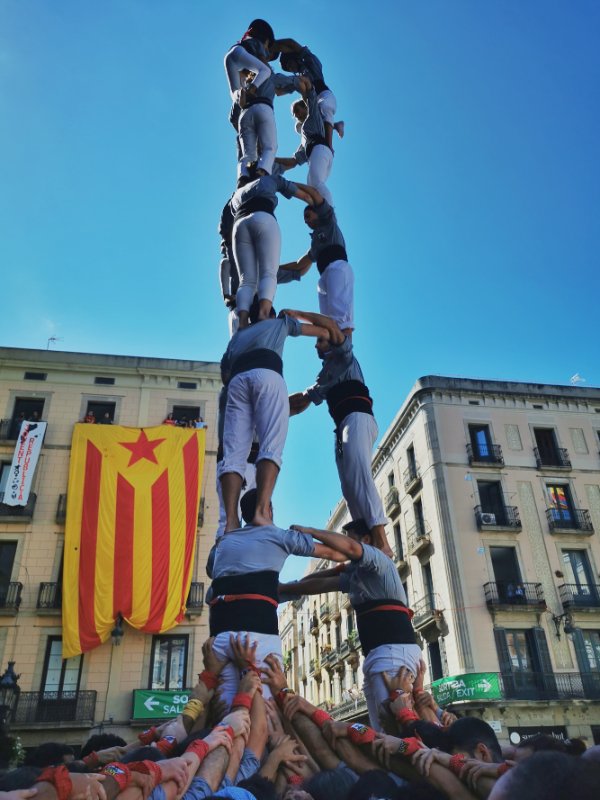
The oldest casteller team (colla castellera) in Barcelona today is the Castellers de Barcelona, founded in 1969. There are various teams of Castellers in Barcelona who perform regularly at events; based in different areas of the city, including:
-
Castellers de Barcelona – red shirts.
-
Castellers de la Vila de Gràcia – dark blue shirts
-
Castellers de Sants – grey shirts
-
Castellers del Poble-Sec – light blue shirts
-
Castellers de la Sagrada Família – bright green shirts
-
Colla Castellera Jove de Barcelona – dark red shirts
-
Castellers de Sarrià – burgundy shirts
-
els Esquerdats, la Colla Castellera de l’Esquerra de l’Eixample – purple shirts
There are other teams in the rest of Catalonia too, so if you are travelling around the region you may come across other performances for festivals and other special events.
For example, the castells team in Girona are known for their performances during the Narcissus Festival, where they build a tower and climb up the steps to the cathedral!
What do Castellers Wear?
When performing, each of the teams performs in their own colours, with the bright-coloured shirt of their team and a black sash (called a faixa) wrapped tightly around their back and waist to provide some support for them, and something for the climbing castellers to grip onto.
They have white trousers and often wear supports wrapped around their wrists or waists to help with grip. The base of the castells wear shoes, but the ones climbing are barefoot.
The younger castellers in the pom de dalt also wear protective helmets, which has been mandatory since 2012.
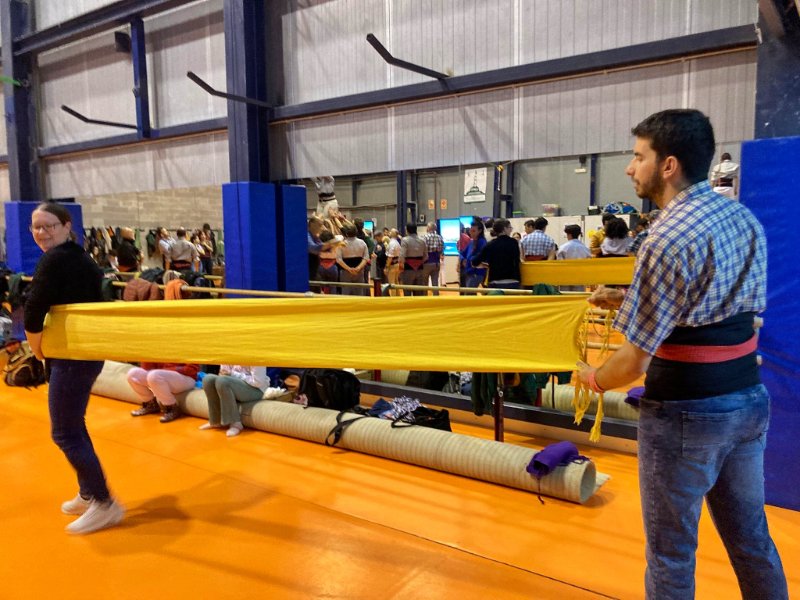
When practising they usually wear jeans and a shirt that covers the shoulders, with their usual sash. We were given different coloured sashes to stand out from the regular team members
How to Watch a Castellers Performance
Local festivals are the best opportunities to see different teams of castellers perform, and if you’re lucky enough to catch a casteller performance during a local festival, you can see for yourself how impressive it is, which never ceases to amaze me!
This website has a calendar of all the teams that perform in Catalonia, and you can filter it by date and/or location to see if you might be able to watch them during your visit. The busiest period is over the summer, with some performances in spring and autumn, but not many in winter as it is an outdoor activity that can’t be done in heavy rain due to safety issues.

The Concurs de Castells
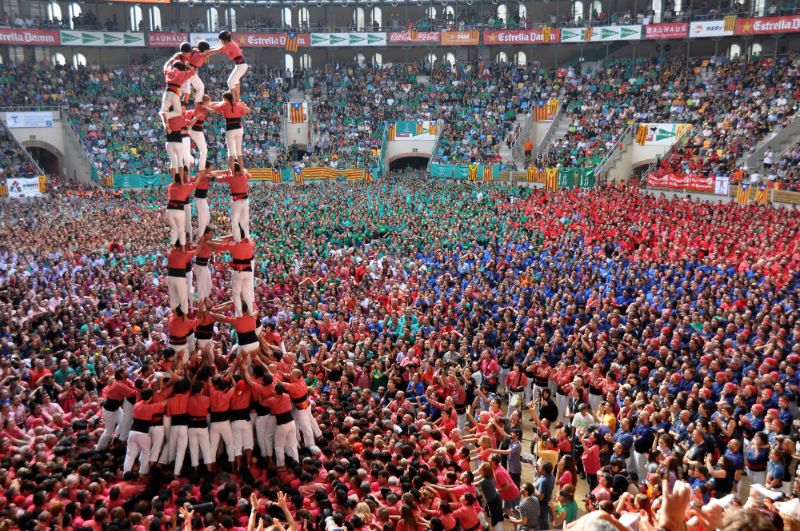
The Concurs de Castells de Tarragona (Castells Competition of Tarragona) is the world’s most prestigious human tower competition. Held every two years in October (in even-numbered years), it brings together the best casteller teams (colles) from across Catalonia to compete by building the tallest and most technically difficult human towers.
It is the only major casteller event where performances are judged and awarded points, making it the highlight of the casteller calendar. The main competition takes place at the Tarraco Arena Plaça (TAP), Tarragona’s former bullring, which can accommodate around 7,000 spectators.
Unlike a normal castells performance, where the emphasis is on tradition and collaboration, the Concurs is competitive. Each castell has a points value according to its difficulty. Teams usually attempt three main towers plus a pillar (pilar), and their highest-scoring successful constructions determine the final rankings. Towers that are fully completed and safely dismantled (descarregats) score more highly than those that are only completed but collapse on the descent (carregats).
You can learn more about the competition on the official website here.
Watching Castellers Rehearse
The teams also practise at their own locals or clubs, so you may be able to watch a practice session and even take part! If you live in Barcelona you could even apply to join a team of castellers, most castellers colles are looking for new members so they can build bigger and more complex castles.
If you’d like to go along to a practise, rehearsals are free to watch, and visitors are generally welcome. Unlike performances, rehearsals give you a chance to see how the human towers are built step by step, from the pinya (base) to the upper levels, with coaches stopping to explain techniques and correct mistakes. It’s one of the best ways to understand how castells work.
The upper levels and lower levels are usually practised separately, it is rare for the complete castle to be built during rehearsal.
The upper levels often have a base or pinya around them, but not touching them, like in the photo below. The pinya is there to support them if needed, but during the performance they would have to do it alone as they would be on top of the pinya, without support.
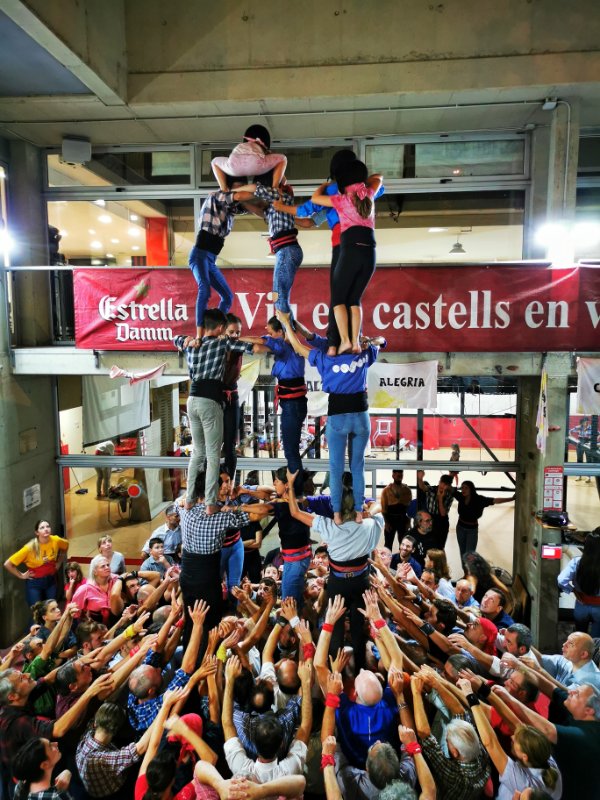
A friend of mine is a member of the Castellers de Barcelona colla so I went with her to a couple of practises, and even got to take part in the pinya as part of the base of the castell during La Merce festival. It was an amazing experience.
The rehearsals take place at their headquarters on Carrer de Bilbao 212–214 in the Sant Marti neighbourhood of Barcelona, and their regular rehearsal schedule is:
- Tuesday: 19:00–20:00: children’s training (canalla) and 20:00–21:45: general rehearsal
- Thursday: 19:00–20:30: Castells school (training and instruction)
- Friday: 19:00–20:00: pillar practice, 20:00–21:00: children’s training and 21:00–23:30: general rehearsal
The Friday rehearsal is usually the best day to go. As a spectator, you can normally watch free of charge, taking photos as long as you don’t interfere with the practice. Make sure you follow any instructions from members, and if their not busy you can chat with them.
If you’re interested, they’ll often happily explain what’s happening, especially if you let someone know you’re visiting. Not everyone speaks English but there is usually someone who can explain what is going on. You can also contact them via their website beforehand to check the details and schedule. Their Instagram page also has updates on the practises and performances.
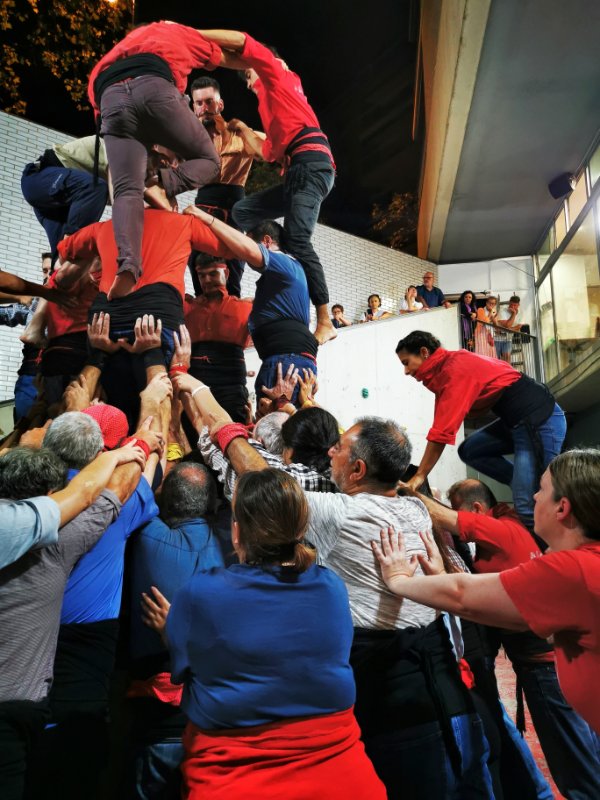
Also, as part of my Catalan classes we visited the Castellers de Sant Cugat to watch and take part in one of their practises. The team were all welcoming and friendly – and took the time to explain the different parts of the castle and the roles that everyone played. We also got to be part of the pinya (base) here too.
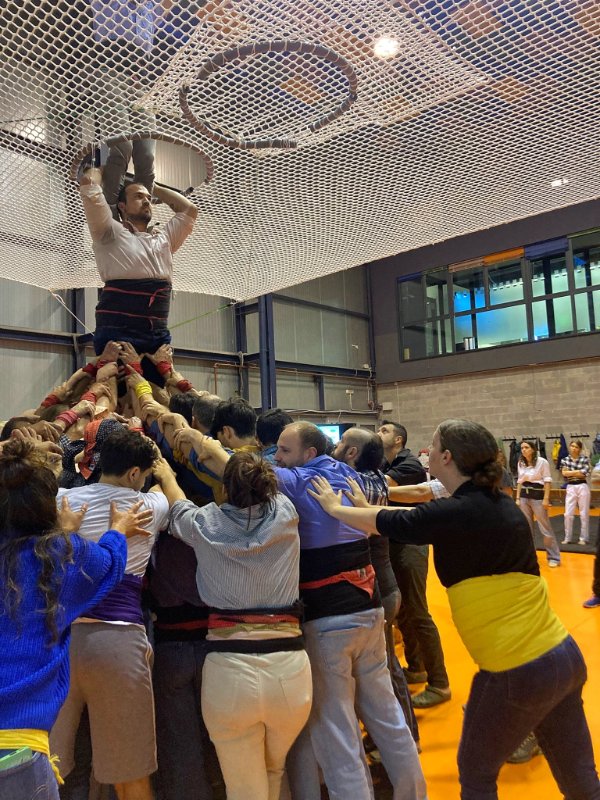
The two practises gave me even more appreciation of how difficult it is to make these human towers! Afterwards I was aching and exhausted but I’m so glad I got to take part.
I’ve also seen this experience on GetYourGuide, where you have a local craft beer tasting and take part in a practise with the Castellers de Gracia colla
There are also other castellers teams around the world, started by Catalans who moved abroad and wanted to take the tradition with them. You can find Castellers teams in London, Paris, Copenhagen, Boston, Santiago, Sydney and Tokyo, as well as several other cities across the globe. See if you can find a colla near you!
Museums, Scultpures & Artwork in Honour of Castellers
If you don’t get a chance to see the castellers in action, you can still learn more about them or see them represented in artwork.
Museu Casteller de Catalunya
The main museum dedicated to castells is the Museu Casteller de Catalunya, located in the town of Valls, around 100 km southwest of Barcelona.
Valls is known as the birthplace of the castellers, where the first human towers were developed over 200 years ago. The museum opened in 2023 and has immersive audiovisual exhibits where you can learn about the history and evolution of castells and discover how towers are constructed and the roles within a colla.
The interactive and 360° audiovisual installations recreate the feeling of being inside a human tower so you get a taste of what it’s like to be a casteller, and learn why castells were recognised by UNESCO as Intangible Cultural Heritage of Humanity in 2010.
I haven’t been there yet but it’s on my list – have you been? Let me know what you thought!
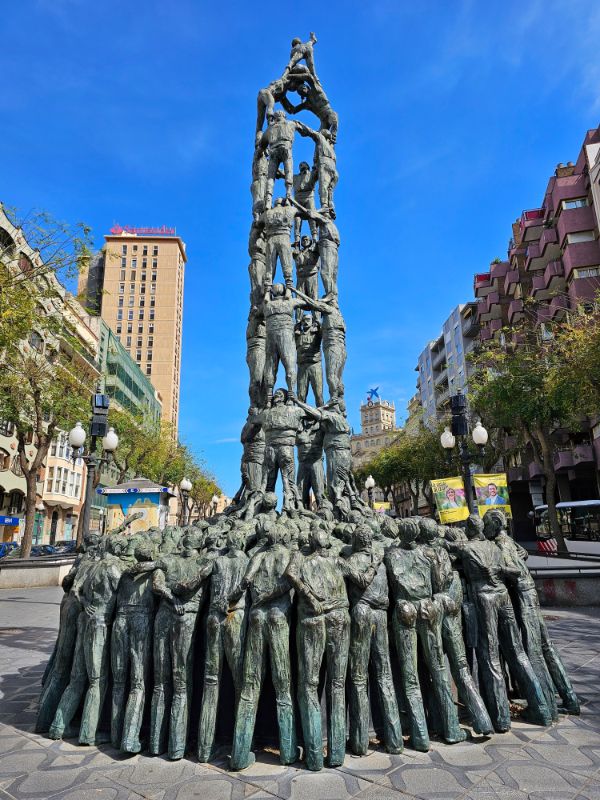
El Monument als Castellers Tarragona
In Tarragona there is a statue dedicated to the castellers – it isn’t as impressive as the real thing but if you’re in Tarragona make sure you go and see it!
Casteller Tiles on Carrer Petrixol
On Carrer Petrixol near the Cathedral of Santa Maria del Pi there is a lovely tile artwork depicting a team of castellers
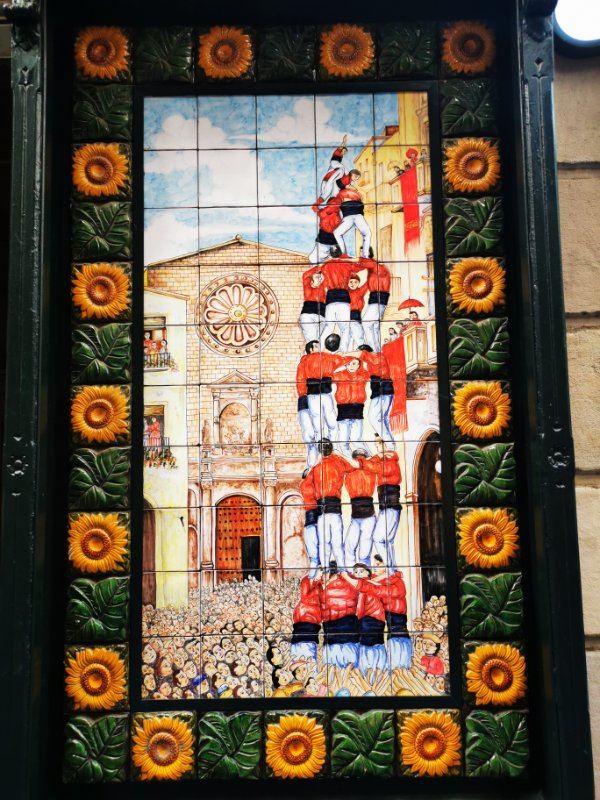
The Monument to the Castellers in Plaça de Sant Miquel
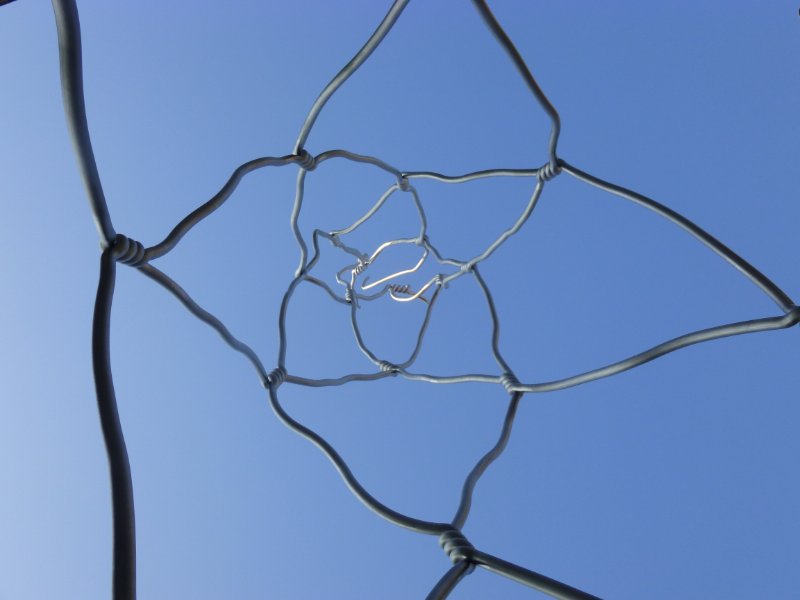
Behind Plaça Sant Jaume in the Gothic Quarter you’ll find a more abstract monument to the Castellers; a tall steel sculpture that looks more like a barb wire tower than a human one! The monument was created by Catalan sculptor Antoni Llena and inaugurated in 2012, two years after castells were inscribed on UNESCO’s List of the Intangible Cultural Heritage in 2010.
Barcelona City Council commissioned the sculpture as a tribute to the casteller tradition, although there were (and still are) many people who would have preferred a more traditional tribute like the one in Tarragona.
I hope this has helped you to understand more about the importance of castells and how difficult they are to build. It is a unique and exciting tradition that is so impressive to watch. Have you seen the castellers perform? Head over to our Facebook group and share your experience, and photos!