
Barcelona is a very walkable city, and beautiful to look at, so if you have the time and the inclination, I’d recommend walking as much as you can to take in the ambience of the city. However, if you prefer a quicker or easier way to get around Barcelona to ease your aching feet, then there are lots more options to choose from. In this article, I’ll share how to get around Barcelona with public transport, taxis, bikes and some suggestions for driving in Barcelona. So let’s get exploring!
Public Transportation in Barcelona
Barcelona has an excellent public transport system that can get you anywhere in the city that you need to go. All public transport here is generally very safe and clean – although pickpockets can be a problem, so keep a hand on your belongings at all times!
Barcelona Transport Zones
Barcelona’s transport network is divided into different zones. The most commonly used zone for visitors is Zone 1, which covers the entire city of Barcelona and the immediate surrounding areas.

You can also find a map of the zones on the official TMB website here. Anything within the Tarifa Metropolitana (marked in pink on the image above) is included in Zone 1.
If you plan to travel outside Zone 1, such as using the metro to get to the airport or visiting nearby towns, you may need to purchase additional zone tickets or pay an extra fare.
Confusingly, the Renfe Rodalies train to the airport is included in Zone 1 transport tickets, but the L9 metro to the airport is not.
For day trips to places like Sitges, Blanes etc, it is generally cheaper to buy a return ticket for that specific destination than a multi-journey ticket for the extra zones. For example, Sitges is in Zone 3, and Blanes is in Zone 5.
For trips to Montserrat by train, buy the combined tickets at the FGC train station at Placa d’Espanya which include either the rack railway ticket or the cable car from the train station, as well as the train journey from Barcelona.
Barcelona Transport Tickets
Barcelona’s public transport has an integrated ticket system, which means you can use the same ticket(s) for the metro, buses, trams, Montjuic Funicular and suburban trains within certain zones (FGC railway lines, and Renfe Rodalies trains).
Once you have validated your ticket, you can switch between lines and other transport options as many times as you need, for a total journey time of up to 75 minutes – as long as you are still in the correct zone.
If you just want to take a single journey on the bus, you can buy a single ticket on the bus with a credit card, but to take the metro, tram or other transport, you will need to purchase a ticket from the machines and validate it when you board.
Children under 4 travel free, but everyone else will need a ticket.

Types of Transport Tickets
Since the beginning of 2024, the Barcelona transport ticket system has been called T-mobilitat, and you can buy rechargeable tickets at the machines (or online if you are a resident in Spain).
You can buy the following tickets at the machines in all metro stations in Barcelona:
- Hola Barcelona Travel Card for unlimited travel on public transport for 2, 3, 4, or 5 days
- A single ticket for any of the integrated public transport options
- A single airport ticket for 1 metro journey to or from the airport
- The T-casual 10-journey single-person ticket
- The T-dia single-person 1 day ticket
- The T-familiar 8-journey multi-person ticket valid for 30 days
- The T-grup 70-journey multi-person ticket valid for 30 days
- The T-usual single person ticket for unlimited travel on public transport for 30 days (great value for stays of 3 days or more)
The longer duration tickets, such as the T-Usual, ask for your ID (Passport or Spanish ID) number when you are buying the ticket, which is then printed on the ticket to show it belongs to you. Once the ticket has expired, you can recharge the same ticket at any ticket machine in any metro station in Barcelona.
T-mobilitat also has an option for using your mobile phone to buy and use as a contactless ticket, however, the app is not user-friendly, so it’s easier just to buy tickets from the machines at any metro station (including at the airport).

Most Common Barcelona Transport Tickets
The most common types of transport tickets for visitors to Barcelona are:
Hola Barcelona Travel Card
This travel card is designed for visitors who are in Barcelona for 2 to 5 days and provides unlimited rides on public transport, including the metro, buses, trams, and suburban trains in zone 1, within the specified time period. It also includes the metro or train journey to and from the airport. It doesn’t include Night Buses.
You can buy the Hola Barcelona Travel Card online in advance here, or from the ticket machines. Read more about the Hola Barcelona Travel Card here.
Hola Barcelona Travel Card Cost in 2026:
- 48-Hour/2 Day Public Transport Ticket: € 18.70
- 72-Hour/3 Day Public Transport Ticket: € 27.30
- 96-Hour/4 Day Public Transport Ticket: € 35.60
- 120-Hour/5 Day Public Transport Ticket: € 43.60
The Hola Barcelona Card can be great value if you are in Barcelona for 2 days and plan on taking several journeys during your stay. However, current subsidies on public transport prices mean that if you are staying in Barcelona for 3 days or more, then the T-Usual unlimited transport ticket is cheaper (more on that below).
If you also plan to visit lots of museums while you are in Barcelona then the Barcelona Card could be better value for you as it also offers discounts and free admission to certain museums and attractions, as well as unlimited transport during the duration of the ticket. It’s valid for between 3 and 5 days with prices starting from €67 for 3 days.

T-Casual
This is a single-person, multi-journey card that allows for ten separate trips by one person on the metro, buses, trams, and suburban trains within Zone 1 of the Barcelona transport network, including the R2 train to the airport.
Cost: €13.00 for 1 zone (plus 50 cents for the card if you buy a new one, there is no added cost for topping up your existing card)
NB: The T-Casual replaced the popular T-10 which could be shared between multiple people – the T-Casual cannot be shared, each person must purchase their own ticket.
T-dia Card
An individual travel card allowing one person to have an unlimited number of journeys during one day on all operators in the integrated transport system. It is valid for 24 hours (1 day) from the time of the first validation. You can also use it for a maximum of one round trip to or from Aeroport T1 and Aeroport T2 metro stations on line L9 Sud, or the train journey from and to the airport.
Cost: €12 for 1 zone.
Single Ticket (Bitllet senzil)
A single ticket is valid for a single journey on the transport network, including transfers, within the zone 1 city limits. It is not valid for metro stations Aeroport T1 and Aeroport T2 on line L9 Sud, but you can use it for a bus journey or the Montjuïc funicular.
Cost: €2.90
Single Airport ticket (Bitllet aeroport)
Trips to the airport on line L9 are not included in the standard metro tickets, so if you travel to or from the airport on the metro, you will need one of these airport tickets. It is valid for a single metro journey to or from the airport on the metro network.
Cost: €5.90
T-usual card
A month-long travel card for unlimited journeys on all operators in the Integrated Fare System, including night buses and the R2 train to the airport. It is great value if you are spending several days or weeks in Barcelona on a Workation or as a Digital Nomad. Thanks to current subsidies from the government, this ticket is currently 50% less than its usual price, so is excellent value.
Cost: from €22.80 for 1 zone (plus 50 cents for the card if you buy a new one; there is no added cost for topping up an existing card)
T-familiar Card
The T-familiar card is a multi-person travel card allowing 8 journeys in 30 consecutive days from the first validation, so it is useful for families who only want to take one or two journeys on the metro, or couples for 4 journeys each for example.
Cost: €11.50 for 1 zone.

Which Barcelona Transport Ticket is Best for You?
Which Barcelona metro ticket you buy will depend on how many times you are likely to take the metro, bus or other public transport in Barcelona.
Most tourists tend to buy the Hola Barcelona Travel Card, which is good value as long as you are going to make use of it and get your money’s worth over the space of 2 or 3 days.
It is very convenient to know that you just have one ticket that will cover all of your public transport needs throughout your trip, and you don’t need to worry about topping up or buying new tickets once you have your Hola Barcelona Card, which is valid for the duration of your stay (from 2 to 5 days).
If you are spending 3 days or more in Barcelona and plan to use the metro a lot, then the T-Usual ticket is even better value and cheaper than the 3-day Hola Barcelona Card. You can buy the T-Usual ticket at any ticket machine in the metro or at the airport train station.
You can buy the Hola Barcelona Travel Card online in advance here, or from the ticket machines at any metro station including at the airport.
If you also plan to visit lots of museums while you are in Barcelona then the Barcelona Card could be better value for you as it also offers discounts and free admission to certain museums and attractions as well as unlimited public transport for the duration of the ticket.
However, if you only plan on using Barcelona public transportation a few times, then you might not need to buy the Hola Barcelona Card, and a couple of single tickets or the T-Casual 10 journey ticket might be sufficient for your needs. If you’re travelling in a couple or with friends/family, the T-Familiar 8 journey ticket can be shared between you all.
If you are only spending one day in Barcelona and think you’ll take 5 or more journeys, then the T-dia day ticket will be best for you.
If you only plan to use public transport once or twice, a single ticket costs €2.90. Children under 4 travel free.
Topping Up Existing T-Casual Cards
If you need additional journeys, then you can easily top up your travel card at the ticket machines. Just select the option “I already have a card” which will allow you to reload your ticket and save you the 50c fee for getting a new card.

The Barcelona Metro System
The underground Metro system in Barcelona is the easiest public transport network to navigate, but keep a close eye on your belongings and keep your hand on your bag at all times. Barcelona is notorious for pickpockets, so don’t make it easy for them!
The Barcelona metro has 10 lines, identified by a number and a colour. All of the lines begin with a letter L followed by the number, for example, L1 is the red line that runs across the centre of Barcelona from Hospital de Bellvitge to Fondo.
In total, there are 165 metro stations in Barcelona, so chances are you can find one close to where you need to be!
Once you are in the metro system your ticket allows you to change as many times as you need, for a total journey time of up to 75 minutes. You can also switch between the metro, buses and trams and other integrated transport for up to 75 minutes as well.
➡️ Read more about the Barcelona metro

Barcelona Buses
The bus system can be a bit confusing as there are so many intersecting lines and routes, so a map of the routes isn’t that helpful. However, if you have wifi access, then Google Maps will tell you the best route to take. Many bus stops have a screen which tells you when the next bus is due, and each bus now has an information board that announces the next stop so you can see where to get off.
In general, to get somewhere quickly, I’d recommend the metro over the bus as the traffic in Barcelona can be horrendous, especially during rush hour. However, being overground is more scenic, and if you don’t have a time limit then it can be a more pleasant way to travel and see more of Barcelona as you go.
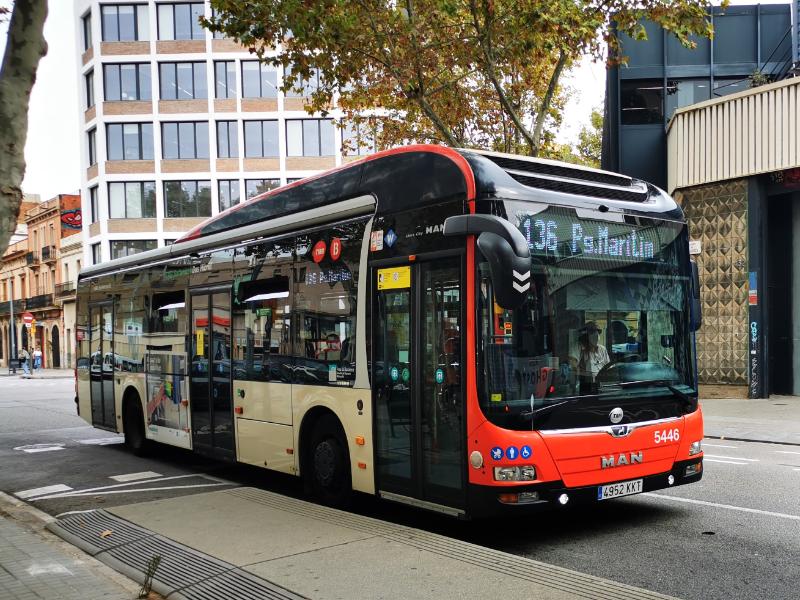
When you get on the bus make sure you scan your T-mobilitat card at the machine to validate your ticket, or use your contactless credit card to buy a single ticket at the machine by the driver.
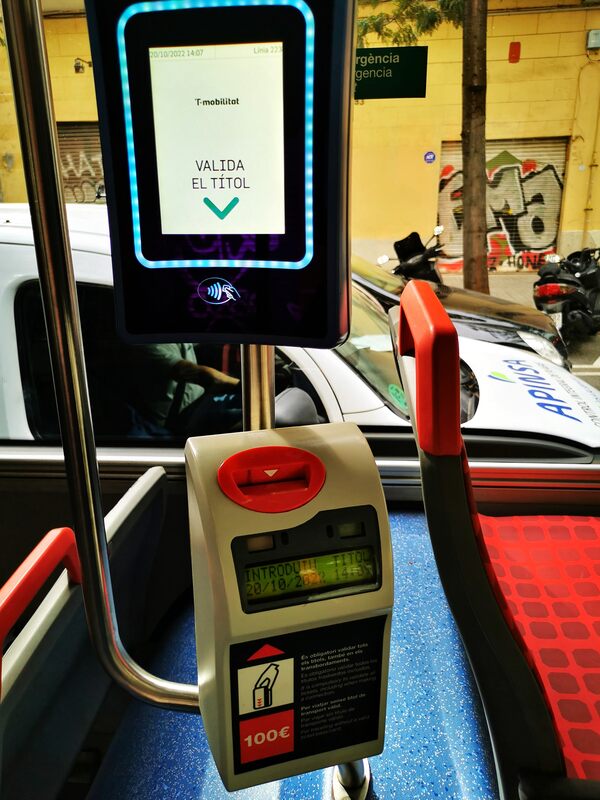
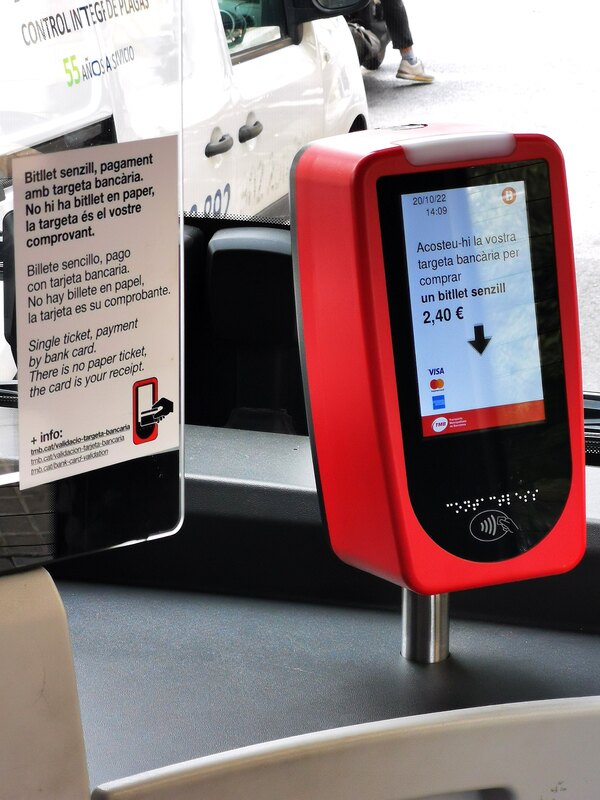
The Aerobus to Barcelona Airport
Barcelona Aerobus is run by a private company and is not part of the integrated transport system, so you cannot use your T-mobilitat tickets on the A1 or A2 Aerobus lines to/from the airport.
You’ll need to buy a separate ticket either online in advance or as you board the bus. These buses are not like the usual red and black buses; they are bright blue, so you’ll know they are different!
A1 Aerobus goes from Plaça de Catalunya to Terminal 1 and A2 goes from Plaça de Catalunya to Terminal 2. There are a couple of stops in between, but the price is the same wherever you get on or off.

Hop on Hop Off Buses in Barcelona
There are two main hop-on hop-off bus services in Barcelona: Barcelona City Tour and Barcelona Bus Turístic. Both offer open-top double-decker buses, audio guides in multiple languages, and routes that cover the city’s main attractions.
Both services also cost around the same, €33 for a 24-hour ticket, and the routes are quite similar. They can be a good way to get your bearings in the city, but at peak times there can be long lines to board the buses, and you’ll have to stick with their timetable, which isn’t as frequent as public transport.
Barcelona City Tour Hop on Hop Off Bus
Barcelona City Tour has bright red buses and is run by Grupo Julià. They operate two routes, east and west, covering over 30 stops, including Montjuïc, the Gothic Quarter, Sagrada Família, Park Güell, and Camp Nou.
The buses are modern, wheelchair accessible, and some are fully electric. A nice feature is the app with real-time bus tracking, which helps reduce waiting time, and tickets sometimes include extras such as discounts for museums or even a catamaran cruise.
Barcelona Bus Turístic
Barcelona Bus Turístic is managed by TMB (the public transport system) and Barcelona Turisme. It usually runs two or three routes, depending on the season. Like City Tour, it offers audio guides, free Wi-Fi, and accessible buses.
One of its biggest advantages is the coupon booklet included with tickets, which offers discounts for popular attractions like the Aquarium and La Pedrera. They also have special seasonal buses to see the Christmas lights, which can be fun!
Barcelona Trams
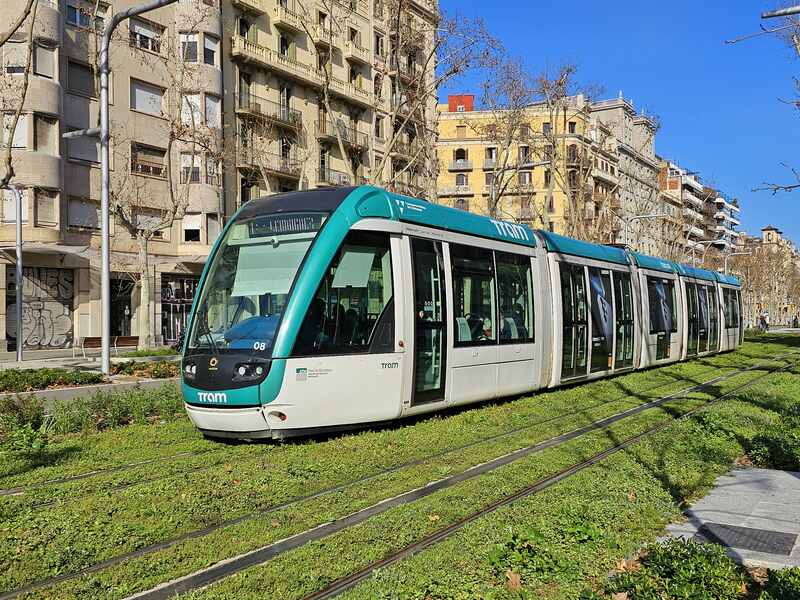
There are six tramlines in Barcelona which you can also use with your T-mobilitat transport ticket. The Barcelona tram network is divided into two areas.
The network made up of lines T1, T2 and T3 has a shared section of 6 km and runs through the municipalities of Barcelona, l’Hospitalet de Llobregat, Esplugues de Llobregat, Cornellà de Llobregat, Sant Joan Despí, Sant Just Desvern and Sant Feliu de Llobregat.
Lines T4, T5 and T6 make up the Besòs network. T4 and T6 link Barcelona with Sant Adrià de Besòs, and T5 connects Barcelona with Badalona.
Local Trains in Barcelona
Barcelona has two main local and regional train networks: FGC (Ferrocarrils de la Generalitat de Catalunya) and Rodalies de Catalunya (often called simply Rodalies or Renfe) which run several lines to take you further out of the city to explore more of Catalonia. There is also a direct train to the airport.
Although they are separate systems, both connect well with the metro and other forms of public transport, and as long as you have a ticket for the appropriate zone, you can use your T-mobilitat card to travel on all of them.
FGC Trains in Barcelona
FGC is operated by the Catalan government and functions almost like an extension of the metro. Its trains are modern, frequent, and very clean, serving mostly the north-western suburbs such as Sabadell, Terrassa, and Sant Cugat.
FGC also runs lines into Montserrat, departing from Plaça d’Espanya (although you’ll need a separate ticket for the train and journey by rack rail or cable car up to the Monastery). In central Barcelona, the main stations include Plaça de Catalunya, Provença, Plaça d’Espanya, and Gràcia.
Rodalies de Catalunya Trains
Rodalies, on the other hand, is operated by the Spanish national rail company Renfe, but managed regionally by the Catalan government. It covers a much wider area than FGC, linking Barcelona with towns and cities across Catalonia.
This makes it particularly useful for day trips to destinations like Sitges and towns along the coast such as Sant Pol, Blanes, and others. Within Barcelona, major Rodalies stations include Sants, Passeig de Gràcia, Plaça de Catalunya, El Clot-Aragó, Estació de França and Arc de Triomf. The trains are larger and less frequent than FGC services, and they feel more like regional rail rather than an urban metro system.
Trains to Barcelona Airport
Rodalies also run the train to El Prat airport, which goes to the station at Terminal 2. Zone 1 tickets can be used on Rodalies trains to go from the centre of Barcelona to Barcelona El Prat airport Terminal 2 (but you cannot use the L9 metro to go to the airport if you only have a zone 1 ticket).
You can catch the R2 train to the airport from Clot-Arago, Passeig de Gracia and Sants stations in central Barcelona, as well as others outside the city.
If your flight is from Terminal 1, you can get the free shuttle bus between terminals.

Barcelona Taxis
There is a stupid amount of taxis in Barcelona, so if you need to get anywhere fast, you can easily flag one down. They all have a meter and should use it. Official Barcelona taxis are black and yellow, so don’t get in cars of a different colour.
Available taxis have a green light on the top, and once they have passengers, the light turns red. All taxis accept card payments and should accept wheelchairs, service dogs and luggage with no extra cost.
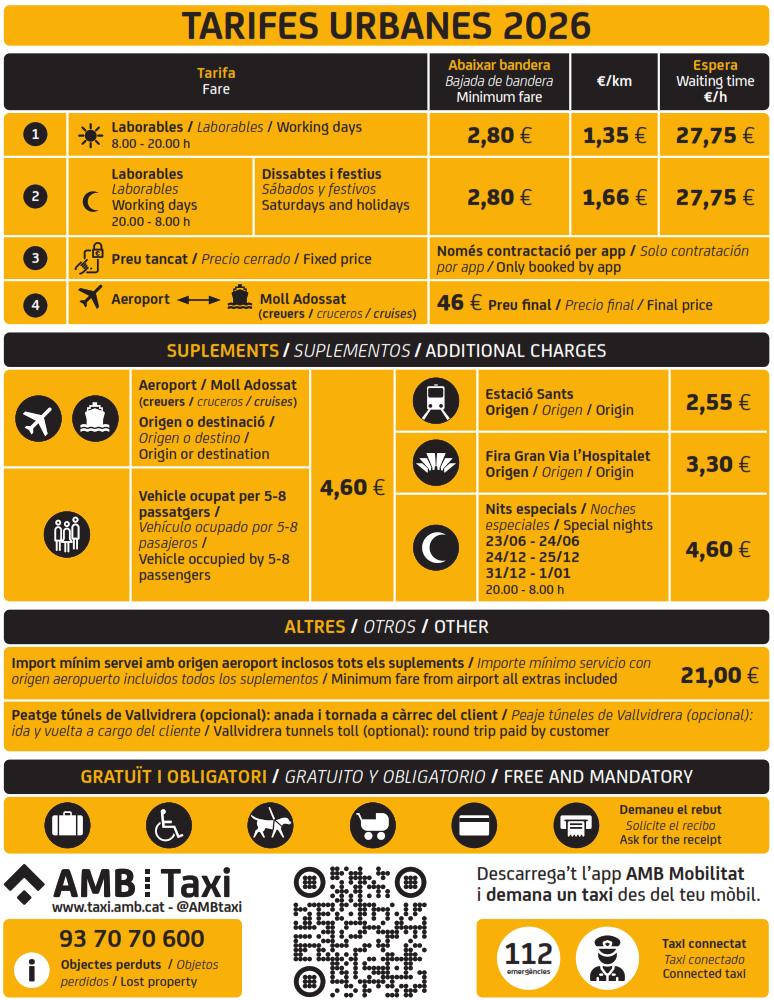
Taxis to/from Barcelona airport have a minimum fare of €21, and depending on where and when you are going, taxi prices from Barcelona airport to the city centre tend to be anywhere between €25 and €45. A taxi from the airport to the cruise ship terminal (or vice versa) is a set fee of €45.
Generally, most taxi drivers are honest and will charge you according to the meter. If you feel like you are being taken advantage of or being charged more than the meter, make sure you get a receipt of your payment and make a note of the taxi number and license plate so you can report the incident to the Metropolitan Institute for Barcelona Taxis.
This is the current list of taxi prices in Barcelona for 2026:
Uber in Barcelona
Uber is now available in Barcelona (after being previously banned, and potentially it could be banned in the future again), but it is often more expensive and takes longer than normal taxis.
If there are no taxis available to flag down on the street, you can use the Uber app to call a taxi, which will either be a fixed price according to the app, or charged as per the meter, depending on the option you select in the app.
I prefer to use the FreeNow app to order a taxi as I’ve found it to be more reliable.
You can get 50% (up to 6,00 €) off your 1st Freenow trip when you use my referral code: 5g66isxps ➡️ download the app here
Other ride-sharing Uber alternatives in Barcelona include Cabify and Bolt – Lyft is not available in Barcelona.

Hire a Car
I actually don’t recommend hiring a car in Barcelona unless you plan to spend a lot of time outside of the city exploring Catalonia. The traffic in Barcelona can be horrendous, and parking spaces are difficult to find as well as expensive.
However, for day trips and weekend trips from Barcelona then hiring a car could be a good option for you.
➡️Read more about car rental in Barcelona

Looking to Hire a Car in Barcelona?
Get a quote for car hire with Discover Cars who compare car rental deals from trusted suppliers in Barcelona like Alamo, Avis, Budget, Centauro, Enterprise, Europcar, Hertz, SIXT and many more, so you know you're getting a great deal.
Hire a Scooter
Hiring a scooter in Barcelona could be a quick and easy way to get around the city without having to rely on public transport. It is easier to find a spot to park (often on the pavement) than driving a car, but the traffic can still be hair-raising if you’re not a confident rider. If you do hire a scooter, make sure you wear a helmet! Cooltra is popular for scooter hire in Barcelona
Hire a Bike
Renting a bike in Barcelona is a great idea, especially if you want to ride along the coast. There are cycle lanes criss-crossing the city as well as various cycle tours of Barcelona if you just want to see the sights in a few hours.
The red and white Bicing bikes are just for Barcelona residents so you can’t use those, but there are lots of options for bike hire companies.
If you do hire a bike, wear a helmet at all times for your own safety and stick to the cycle paths wherever you can. Riding on pavements is not permitted and you can be fined up to €500.
Bear in mind that travelling by bike from the coast up to Gràcia or Park Güell means cycling uphill – you can also hire an e-bike in Barcelona, which is much easier than pedalling!
How to Get Around Barcelona FAQ
If you don’t find the answer you’re looking for here, head over to our Facebook group to ask our Barcelona travel community.
What is the Best Way to Get Around Barcelona?
The metro is usually the fastest and most convenient option for visitors, as it connects most of the main attractions. Buses, trams, and local trains (FGC and Rodalies) are also easy to use, while walking is perfect for exploring neighbourhoods like the Gothic Quarter or El Born.
Is Public Transport Safe in Barcelona?
Yes, Barcelona’s public transport system is safe and reliable. The main thing to watch out for is pickpockets, especially on busy metro lines and at tourist hotspots, so keep an eye on your belongings.
Is Public Transport in Barcelona Accessible?
Yes, Barcelona’s public transport network is generally very accessible. Most metro stations now have lifts and step-free access, although a few older stations are still being upgraded. Buses are all wheelchair accessible with ramps, and trams are low-floor, making boarding easy. Rodalies and FGC trains have designated spaces for wheelchairs and prams, though at some smaller stations the platforms may not be fully step-free.
Before you travel, it’s a good idea to check station facilities in advance using the TMB or Renfe apps. You can get more information about accessibility on the TMB website here.
Can I use the Same Ticket for the Metro, Bus, Tram, and Train?
Yes, most Barcelona transport tickets, such as the T-casual or Hola Barcelona Travel Card, are valid across the integrated transport system, which includes metro, bus, tram, FGC (within city zones), and Rodalies commuter trains inside the same zones.
How Much Does Public Transport Cost in Barcelona?
In 2025, a single metro or bus ticket costs €2.55. If you’re staying a few days, multi-use tickets or travel passes like the T-casual, T-familiar, or Hola Barcelona Travel Card offer much better value.
How Late does the Metro Run in Barcelona?
From Sunday to Thursday, the metro runs until midnight. On Fridays, it runs until 2 am, and on Saturdays and public festivals, it operates all night.
Do I Need a Car to Get Around Barcelona?
No, a car isn’t necessary. In fact, driving in Barcelona can be stressful due to traffic, narrow streets, and limited parking. Public transport, walking, and cycling are much easier ways to move around the city.
Is it Easy to get to the Beach in Barcelona by public transport?
Yes, you can take the metro (line L4, yellow) to Barceloneta, Ciutadella-Vila Olímpica, or Poblenou for quick access to the city beaches. For quieter coastal towns like Sitges or Castelldefels, the Rodalies trains are a good option.
What apps should I use to get around Barcelona?
Google Maps works well for most routes, but local apps like TMB (for metro and bus) and Rodalies de Catalunya are very handy for live updates, delays, and planning trips by train.